Home › Magnetars
⭐ Flagship topic: the section that started the whole projectMagnetars
This site began with a Science Quest project on magnetars, and they remain central to its content. A magnetar is a special kind of neutron star with the strongest magnetic field known anywhere in the universe. They are rare, they release violent bursts of energy, and they exhibit behaviour that can seem extraordinary at first encounter. This is the largest section on the site, reflecting the depth of material on the topic.
Watch: magnetars explained
This NASA ScienceCast describes what magnetars are, how their magnetic fields compare to other neutron stars, and what orbiting telescopes have observed.
What is a magnetar?
When a massive star explodes as a supernova, it can leave behind a neutron star: a city-sized ball with more mass than the Sun crammed into about 20 km. A magnetar is a neutron star that, for a few thousand years, has an absolutely monstrous magnetic field, around a thousand times stronger than an ordinary neutron star, and roughly a quadrillion (1015) times stronger than Earth's.
There are only around 30 confirmed magnetars in our galaxy so far, though astronomers think there could be many more that have gone quiet. They were first proposed by scientists Robert Duncan and Christopher Thompson in 1992, and confirmed by observations in the years after.
Just how strong is the magnetic field?
Magnetars are neutron stars whose magnetic fields rank among the strongest of any known object in the universe, typically reaching between 1013 and 1015 gauss. To grasp what that means, consider familiar scales: Earth's magnetic field is only about 0.5 gauss, while a hospital MRI machine operates at roughly 1.5 to 3 tesla, equivalent to 15,000 to 30,000 gauss. A magnetar's field is trillions of times stronger than even the most powerful MRI, a gap so wide that everyday comparisons barely capture it.
Direct measurements have begun to confirm these extraordinary values. Using China's Insight-HXMT space telescope, astronomers measured what is, so far, the strongest magnetic field ever recorded in the universe: around 1.6 billion tesla, from a magnetar actively stripping material from a nearby companion star. That observation was a direct measurement of a field in action, not an estimate, as the magnetar's gravity and magnetism pulled matter from its neighbour.
When a field reaches this intensity, it does not merely passively exist; it reshapes its surroundings. Magnetic stress can crack a neutron star's solid crust, power bursts of gamma rays and X-rays, and release energy on scales that rival the most violent events in a galaxy. Magnetars are engines driven by magnetic energy stored at a density no laboratory on Earth can reproduce.
Magnetic field strength is measured in gauss (or tesla; 1 tesla equals 10,000 gauss). The numbers below are so spread out that a special scale is used (each step is 10× bigger) to fit them on screen. Buttons run from weakest on the left to strongest on the right. Click one to compare:
Magnetar:
How magnetars form
This part is still being researched, but the leading idea goes like this:
- A very massive star runs out of fuel and its core collapses in a supernova.
- The collapsing core is born spinning extremely fast, maybe hundreds of times a second.
- If the new neutron star spins fast enough and churns inside (a dynamo effect, a bit like what makes Earth's magnetic field, but turbocharged), it can build up a magnetic field a thousand times stronger than normal.
- That gives you a magnetar. The intense field then slowly "brakes" the spin, which is why magnetars actually rotate quite slowly, usually once every 2 to 12 seconds.
A magnetar, drawn with code
Soft gamma repeaters & starquakes
A magnetar's magnetic field is so strong it actually strains the solid crust of the neutron star. Every so often the crust cracks, a starquake, and the snapping magnetic field blasts out a burst of gamma rays and X-rays. Magnetars that do this are called soft gamma repeaters (SGRs), because they repeatedly send out "soft" (lower-energy) gamma rays.
Another group, historically called anomalous X-ray pulsars (AXPs), glow steadily in X-rays. Astronomers now consider SGRs and AXPs the same type of object: both are magnetars, observed in different behavioural states.
Giant flares: among the most powerful events in the galaxy
Once in a while, a magnetar releases something far bigger than a normal burst: a giant flare. These are some of the most powerful explosions in the galaxy.
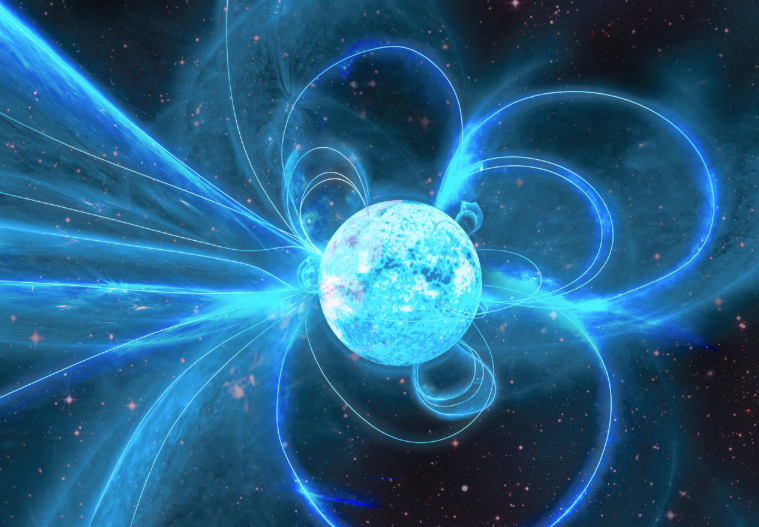
In May 2026, international teams of astronomers confirmed that a powerful gamma-ray signal first detected in 2020 was not a typical gamma-ray burst at all. Re-analysis with data from NASA missions showed that the event was a giant flare, a sudden, extreme release of magnetic energy, from a magnetar in the nearby Cigar Galaxy (M82). Giant flares are among the rarest and most energetic outbursts magnetars produce; identifying this one as a magnetar eruption, rather than a conventional GRB, nearly doubled the small catalogue of giant flares observed outside our own galaxy. The finding shows how magnetars continue to reshape our understanding of the universe's most violent events.
| Event | What happened |
|---|---|
| SGR 0526-66 (1979) | The first giant flare ever detected. It's what made scientists realise something new was out there. |
| SGR 1806-20 (Dec 2004) | A giant flare from about 50,000 light-years away that still managed to disturb the upper layer of Earth's atmosphere. In a fraction of a second it released more energy than the Sun does in many thousands of years. |
| SGR 1935+2154 (2020) | A magnetar in our own galaxy produced a fast radio burst, the first solid evidence that magnetars can cause at least some of these mysterious signals. |
| M82 magnetar (2020 event; confirmed May 2026) | Initially mistaken for a gamma-ray burst, this giant flare from a magnetar in the Cigar Galaxy was identified with help from NASA missions, adding one of the few giant flares known outside the Milky Way. |
This is where magnetars overlap with gamma-ray bursts, the brightest explosions known. Most long gamma-ray bursts come from supernovae and merging stars, but magnetar giant flares can look like short gamma-ray bursts from far away, so astronomers have to be careful telling them apart.
Magnetars vs pulsars vs ordinary neutron stars
Neutron stars, pulsars and magnetars are related but distinct. All three are neutron stars; they represent different observational and physical characteristics of the same class of object:
| Type | The short version | Magnetic field |
|---|---|---|
| Neutron star | The crushed core left after a supernova. | strong |
| Pulsar | A spinning neutron star that sweeps beams of radio waves past Earth like a lighthouse. | strong |
| Magnetar | A neutron star with an extreme magnetic field that powers gamma and X-ray bursts. | about 1000× stronger |
So: every magnetar and every pulsar is a neutron star. Magnetars are just the rare, super-magnetic members of the family.
Current scientific research
Magnetars are a really active research area right now. Some of the big questions scientists are working on:
- Do fast radio bursts mostly come from magnetars? The 2020 event from SGR 1935+2154 suggested some do, but maybe not all.
- Exactly how does a magnetar build such a strong field? In 2025, researchers published a computer-model study in the journal Nature Astronomy that explored one leading idea: when a massive star explodes, some of the blown-off material can fall back onto the newborn neutron star. That falling material, combined with the star's rapid spin, may power an internal magnetic dynamo, a process called the Tayler-Spruit dynamo, named after the scientists who described how fluid motion inside a spinning star can amplify magnetic fields. The models suggest this mechanism could explain how some neutron stars end up as magnetars while others do not.
- What happens deep inside, where matter is denser than an atomic nucleus? Magnetars are natural physics labs we could never build on Earth.
- Telescopes and satellites like NASA's NICER, Fermi and Swift, and ESA's X-ray missions, watch magnetars for bursts.
Why do astronomers study magnetars?
Several reasons make magnetars important to astronomers:
- Extreme physics: they let us test how matter and magnetism behave in conditions we can never make in a laboratory.
- Understanding star death: they're one possible ending for massive stars, so they help complete the life-cycle story.
- Solving mysteries: they may explain fast radio bursts and some gamma-ray bursts.
- Fundamental curiosity: they represent some of the most extreme objects in the universe, and understanding them deepens our picture of how stars end their lives.